
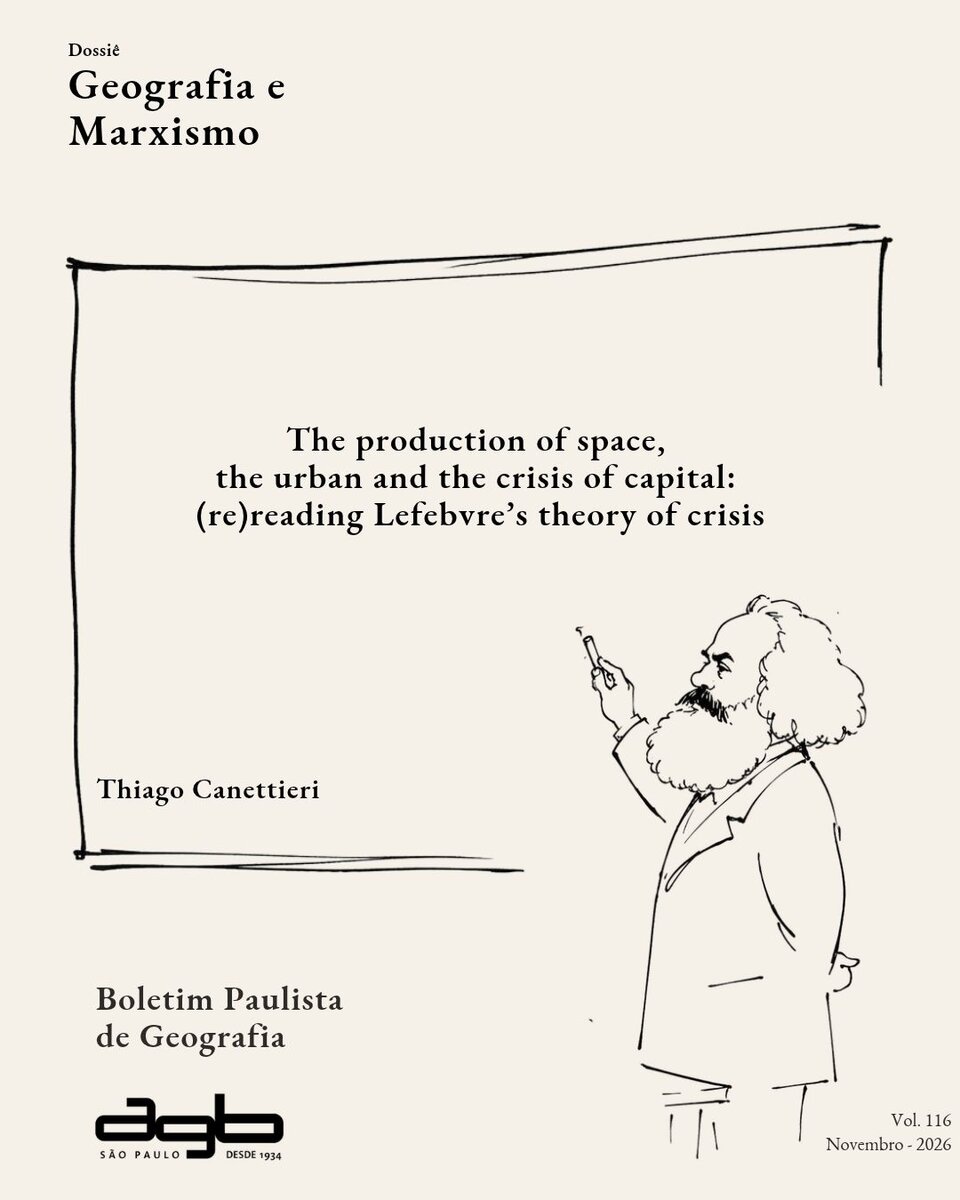
The production of space, the urban and the crisis of capital
(re)reading Lefebvre's theory of crisis
DOI:
https://doi.org/10.61636/g6erdj17Palavras-chave:
Crisis, production of space, capitalism, marxism, labor, Henri LefebvreResumo
This paper examines the concept of crisis in Henri Lefebvre's work, highlighting its significance in his urban theory. Drawing on Karl Marx’s theory of the crisis of capital, the text highlights crisis as an ongoing and destructive process driven by capitalism's inherent contradictions. The article demonstrates how capital’s crisis is linked to the production of space and how capitalist social structures perpetuate deepening Lefebvre's critique of traditional Marxism. By stressing the central role of crisis, the paper enhances understanding of Lefebvre's theory and his critique of traditional Marxism. It also highlights Lefebvre’s contributions to analysing the capitalist crisis.
Downloads
Referências
Benanav, A. Misery and debt: on the logic and history of surplus populations and surplus capital. Endnotes, 2: 21-39, 2010.
Brenner, N.; Schmid, C. Planetary urbanization. In Gandy, M. (ed.) Urban constellations. Jovis, Berlin, 2011.
Brenner, N.; Schmid, C. Towards a new epistemology of the urban. City, 19(2-3), p.151–82, 2015.
Canettieri, T. The dark side of planetary urbanization: operational landscapes, crisis and the peripheral condition. International Journal of Urban and Regional Research, 48(5): 894-914, 2024.
Harvey, D. The urban process under capitalism: a framework for analysis. International Journal of Urban and Regional Research, 2(1-3): 101-131, 1978.
Harvey, D. Limits to capital. London: Verso Books, 1982.
Kipfer, S.; Goonewardena, K.; Schmid, C.; Milgrom, R. On the production of Henri Lefebvre. In: Goonewardena, K.; Kipfer, S.; Milgrom, R.; Schmid, C. (Orgs.). Space, difference, everyday life: reading Henri Lefebvre. New York/London: Routledge, 2008.
Kurz, R. The Crisis of Exchange value: Science as productive force, productive labor, and capitalist reproduction. Mediations: Journal of Marxist Literary Group, 27 (1-2), 1986.
Kurz, R. Der Kollaps der Modernisierung: vom Zusammenbruch des Kasernensozialismus zur Krise der Weltökonomie. Leipzig: Reclam, 1991.
Kurz, R. Geld ohne Wert: Grundrisse zu einer Transformation der Kritik der politischen Ökonomie. Leipzig: Horlemann Verlag, 2012.
Lefebvre, H. La crise du capitalism français: essai de définition du problème. La Pensée, 17: 39-50, 1948.
Lefebvre, H. Le Droit à la ville. Paris: Anthropos, 1968.
Lefebvre, H. Espace et politique: le droit à la ville II. Paris. Anthropos, 1972.
Lefebvre, H. The survival of capitalism: reproduction of the relations of production. New York: St. Martin’s Press, 1976.
Lefebvre, H. De L’Etat: les contradictions de l’État moderne, volume 4. Paris: PUF, 1978.
Lefebvre, H. Le retour de la dialectique: 12 mots-clefs pour le monde moderne. Paris: Messidor, 1986.
Lefebvre, H. The production of space. Oxford: Blackwell Publishers, 1991.
Lefebvre, H. The urban revolution. Minneapolis: University of Minnesota Press, 2003.
Lefebvre, H. Critique of everyday life. London: Verso, 2013.
Lefebvre, H. Metaphilosphy. London: Verso, 2016.
Lefebvre, H. Marxist thought and the city. Minneapolis: University of Minnesota Press, 2016b.
Lefebvre, H. Everyday life in the modern world. London: Routledge, 2024.
Marx, K. Grundrisse: Foundations of the Critique of Political Economy. Harmondsworth: Penguin, 1973.
Marx, K. The Capital: a critique of political economy, volume 1. Harmondsworth: Penguin, 1992.
Marx, K. The Capital: a critique of political economy, volume 3. Harmondsworth: Penguin, 1993.
Marx, K. The German Ideology. Marx/Engels Internet Archive (marxists.org), 2000.
Postone, M. Time, labor and social domination: a reinterpretation of Marx’s critical theory. Cambridge: Cambridge University Press, 1993.
Publicado
Edição
Seção
Licença
Direitos autorais (c) 2026 Thiago Canettieri

Este trabalho está licenciado sob uma licença Creative Commons Attribution 4.0 International License.
Autores que publicam nesta revista concordam com os seguintes termos:
Autores mantém os direitos autorais e concedem à revista o direito de primeira publicação, com o trabalho simultaneamente licenciado sob a Licença Creative Commons Attribution que permite o compartilhamento do trabalho com reconhecimento da autoria e publicação inicial nesta revista.